
.png)
Get to Know your Flow

Updated: Aug 25, 2025
The menstrual cycle is a different experience for every female. Your menstrual cycle is often thought of as your fifth vital sign - a measurement of the body's most basic functions. Your cycle should be easy and appreciated, as it is a sign of health for women. But how do we know what’s normal? How do we know what to expect? and how we should feel each cycle? Let's explore:
The phases of your cycle
When we speak of the menstrual cycle, many will only consider the shedding or bleeding phase of the cycle. There are in fact three other phases to the menstrual cycle that we need to be more aware of. Unlike men, women experience hormonal fluctuations throughout the month. These fluctuations move in sync with the four different phases and dictate a lot... Let's take a look;
Menstrual phase - Your period - the bleeding phase or your Inner Winter. This is the start of a new cycle and lasts for 3-7 days.
Follicular phase - The building phase of your cycle as the lining of the uterus builds back up, it lasts up until ovulation. Also known as your Inner Spring.
Ovulation - An egg is released from an ovary around day 14-15. Your Inner Summer.
Luteal phase - The phase when all of the work is done, your Inner Autumn! If pregnancy hasn’t occurred, by the end of this phase the lining of the womb begins to shed.

During each phase you may experience differences in your:
Physical state - energy may rise and fall, cravings, fatigue,
Emotional state - you may feel more emotional towards the end of the luteal phase,
Mental state - you may feel tired and forgetful, or ‘zoned out’.
Sounds like the dream right? But, this is all as a result of fluctuating hormones. Unlike males and male hormones that stay at a constant consistent level, female hormones rise and fall through each phase, meaning we experience physical, mental and emotional shifts through each cycle. This is in fact a super-power, and it’s something we can use to our full potential when we understand how our bodies really work! So, let’s explore...
Hormones and your cycle - The Science!
As you move through your cycle, your hormones will fluctuate. Understanding your hormones and how they work, is a great place to start in understanding your menstrual cycle. Let's take a look at how these hormones should flow each month.
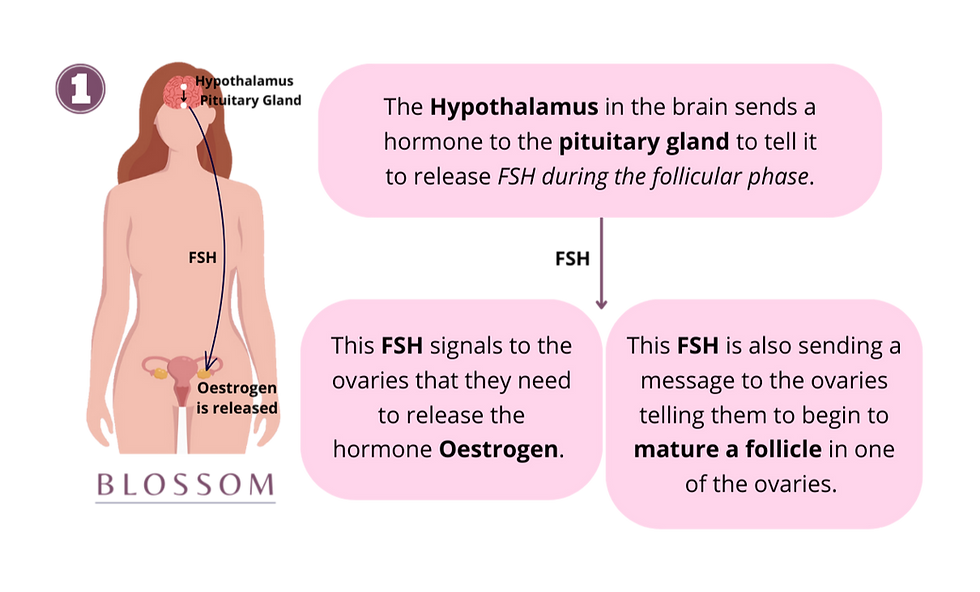
Once the FSH (Follicle Stimulating Hormone) has done its job, enough oestrogen has been released to build the lining of the womb and the follicle has matured, a message (in the form of hormones) is sent back to the pituitary gland to tell it to stop releasing FSH - it's pretty much an internal messaging system! (LH = Luteinizing hormone)

After Ovulation has occurred (normally day 14-15 of an average cycle), and only if ovulation has occurred, your body will start to make the hormone Progesterone. If ovulation has occurred, the corpus luteum, which housed the egg, will break down and produce progesterone during the luteal phase of the cycle.


But could there be more at play than just physical changes?
Throughout your cycle you may notice changes in your energy levels, mood, and even the type of activities you are attracted to. This is in part due to the physical changes that are going on in your body, or the hormonal fluctuations that are happening in your body. The graph below shows you the shifts that occur:
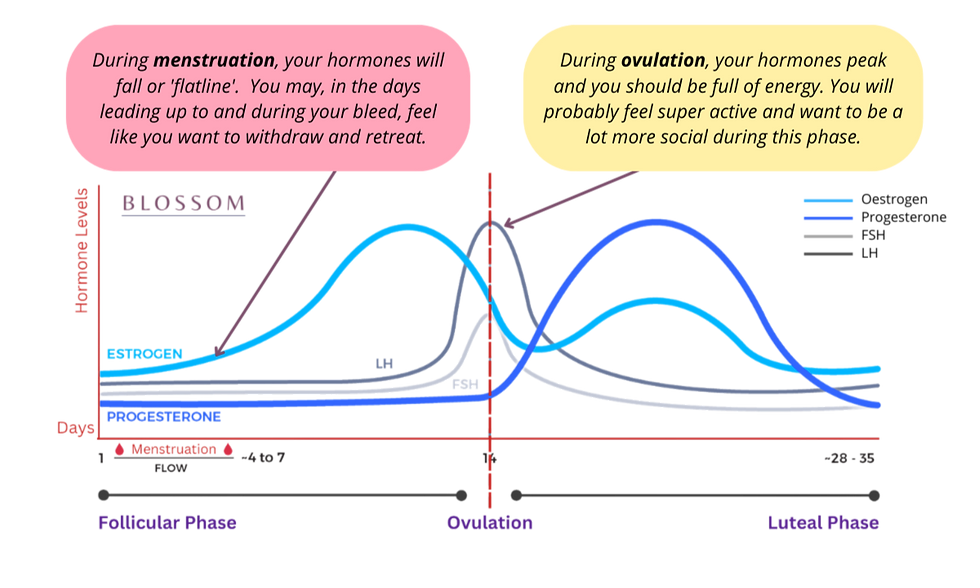
The key to working with your cycle is to discover where your energy peaks and dips, and figure out what activities, lifestyle practices and dietary choices will nourish and support you at each stage, and to do this you will need to track your cycle. For example, during menstruation, a woman's energy tends to want to withdraw inwards and retreat (because hormones 'flatline'). However, as we draw closer to the ovulation phase, our energy peaks and we tend to feel the need to be active and venture outwards. This will constantly shift throughout your cycle.
Ready to understand your cycle on a whole new level?
Follow us on socials for more insights... or better yet, join us in a talk, workshop, or 1-1 session. Whether you're just starting your journey or supporting someone on theirs, be part of the conversation, the movement, and the shift toward menstrual cycle awareness. Let’s end the silence, together.


Comments